
Animals have been part of human life for thousands of years. For many people they are companions, sources of comfort, and sometimes partners in work and daily living.
But animals do more than provide companionship. Research increasingly shows that interacting with animals can influence our stress response, nervous system regulation, social connection, and overall well-being.
This is one reason animals are now intentionally integrated into many health and mental health settings, including hospitals, rehabilitation programs, schools, and psychotherapy practices.
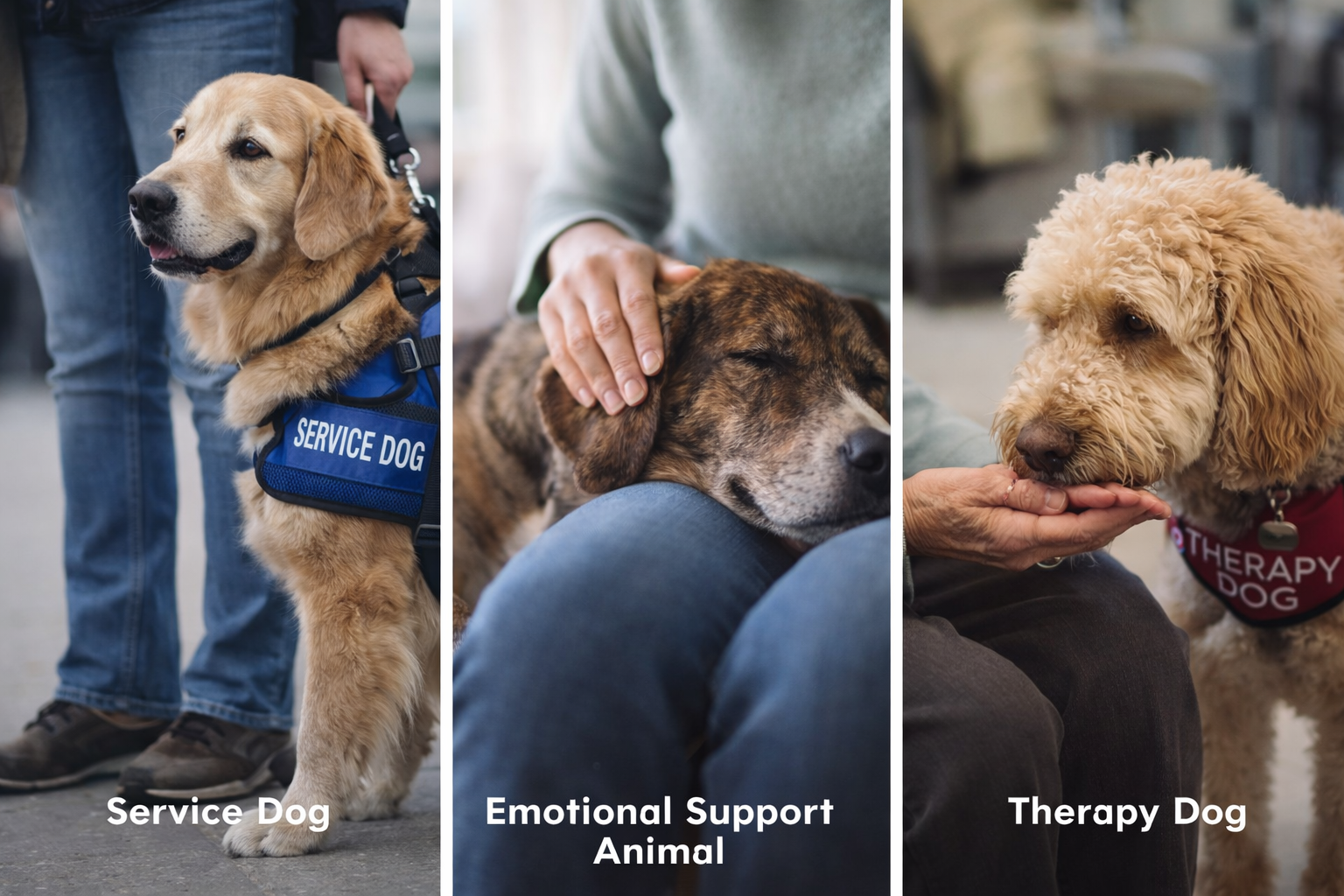
At the same time, there is often confusion about the different roles animals may play in people’s lives. Terms such as service dog, emotional support animal, and therapy dog are frequently used interchangeably, even though they serve very different purposes and have different legal protections.
Understanding the differences between service animals, emotional support animals (ESAs), and therapy animals helps protect both the rights of individuals who rely on these animals and the integrity of the roles these animals play.
Before exploring those distinctions, it helps to understand why animals can have such a meaningful impact on human health in the first place.
The Science Behind the Human–Animal Connection
Most people have experienced the calming presence of an animal at some point: a dog leaning quietly against you, a horse responding to subtle shifts in your body language, or even the quiet companionship of a pet nearby.
These experiences are not just emotional. They are also physiological.
Research on human–animal interaction suggests that positive contact with animals can influence several biological systems linked to stress, emotional regulation, and well-being.
Nervous System Regulation
When people interact calmly with animals, studies have found decreases in heart rate and blood pressure, along with reductions in stress hormone levels.
These changes reflect shifts in the autonomic nervous system, which regulates the body’s stress response.
Gentle interaction with animals may reduce activation of the body’s fight-or-flight response while increasing activity in the parasympathetic nervous system. The parasympathetic system supports relaxation, recovery, and restoration.
For individuals living with chronic stress, anxiety, or trauma responses, this physiological shift toward regulation can make it easier to think clearly, engage socially, and process emotions.
Research overview:
https://www.frontiersin.org/articles/10.3389/fpsyg.2024.1354220/full
Hormones and Stress Reduction
Human–animal interaction has also been linked to changes in hormones involved in stress and social bonding.
Research suggests that spending time with animals may:
• reduce cortisol, the body’s primary stress hormone
• increase oxytocin, which is associated with bonding and trust
• increase dopamine and serotonin, which are linked to positive mood and reward
These biological changes help explain why animals often feel calming, grounding, and emotionally supportive.
Research overview:
https://www.ncbi.nlm.nih.gov/pmc/articles/PMC3408111/
Emotional and Social Benefits
Animals can also help people feel safer and more connected.
In healthcare and mental health settings, interaction with animals has been associated with:
• reduced feelings of loneliness
• increased social engagement
• improved emotional expression
• greater participation in therapeutic activities
Because animals communicate primarily through body language and presence rather than words, they often provide a sense of nonjudgmental connection that can be especially helpful for individuals experiencing stress or emotional difficulty.
Different Roles Animals Play in Supporting Humans
Because animals can have such a meaningful impact on human well-being, several types of working animal roles have developed over time.
The three most commonly discussed categories are:
• Service animals (mostly dogs, miniature horses are allowed)
• Emotional support animals (ESAs)
• Therapy animals (9 types of animals allowed depending on organization)
Each plays a different role, serves a different purpose, and operates under different legal guidelines.
Understanding these distinctions helps ensure that individuals who rely on these animals maintain appropriate access and protections, while animals themselves are placed in roles that match their training, temperament, and intended purpose.
Quick Comparison: Service Animals, Emotional Support Animals, and Therapy Animals
| Feature | Service Animal | Emotional Support Animal (ESA) | Therapy Animal |
| Primary Role | Performs trained tasks for a person with a disability | Provides emotional comfort through companionship | Provides comfort and support to many people in therapeutic settings |
| Training | Individually trained to perform specific disability-related tasks | No specialized task training required | Evaluated and trained for calm temperament and interaction with people |
| Who the Animal Serves | One specific handler | One owner/individual | Many people (patients, students, clients, etc.) |
| Public Access Rights | Yes, protected under the ADA | No public access rights | No public access rights |
| Housing Protections | Yes | May qualify under the Fair Housing Act with documentation | No specific housing protections |
| Common Settings | Daily life with handler | Home environment | Hospitals, schools, therapy offices, nursing homes |
Service Animals
A service animal is defined under the Americans with Disabilities Act (ADA) as a dog that is individually trained to perform specific tasks for a person with a disability.
These tasks must be directly related to the person’s disability.
Examples include:
• guiding someone who is blind
• alerting a person who is deaf
• retrieving items for someone with mobility limitations
• alerting and responding to seizures
• interrupting or mitigating symptoms of PTSD
Key points about service animals:
• They receive specialized task-specific training.
• They work for one individual handler.
• They have full public access rights under federal law.
• Businesses may ask only two questions:
- Is the dog required because of a disability?
- What work or task has the dog been trained to perform?
Businesses may not request documentation, require certification, or ask about the nature of the person’s disability.
ADA service animal guidance:
https://www.ada.gov/resources/service-animals-faqs/
In South Carolina, state law largely aligns with the ADA definition. Comfort or companionship alone does not qualify an animal as a service animal.
South Carolina Code of Laws:
https://www.scstatehouse.gov/code/t47c003.php
Misrepresenting a pet as a service animal can carry fines under South Carolina law.
There are no specific requirements for how a service dog must be trained (for example, professional trainer vs handler trained). Many handlers pursue programs such as the American Kennel Club Public Access Tests to demonstrate that the dog can behave appropriately in a variety of public settings: https://www.akc.org/products-services/training-programs
These training programs and tests may also be used for companion dogs, emotional support animals, and dogs preparing for therapy work.
Emotional Support Animals (ESAs)
An emotional support animal (ESA) provides comfort through companionship. Unlike service animals, ESAs are not trained to perform specific disability-related tasks.
For individuals living with certain mental health conditions, the presence of a companion animal can still be meaningful and stabilizing.
Key characteristics of emotional support animals:
• They do not require specialized task training.
• They do not have public access rights under the ADA.
• They may qualify for housing protections under the Fair Housing Act.
Under the Fair Housing Act, individuals with disabilities may request reasonable accommodation to live with an emotional support animal in housing that otherwise restricts pets. This typically requires documentation from a licensed healthcare provider supporting the therapeutic need for the animal.
Fair Housing Act overview:
https://www.hud.gov/program_offices/fair_housing_equal_opp/fair_housing_act_overview
HUD guidance on assistance animals:
https://www.hud.gov/program_offices/fair_housing_equal_opp/assistance_animals
It is important to note that ESAs generally do not have the right to accompany individuals into restaurants, stores, airplanes, or other public spaces unless the business allows pets.
In clinical practice, mental health professionals may evaluate whether an emotional support animal is an appropriate part of a treatment plan for a person living with a mental health condition. When appropriate, licensed healthcare providers may provide documentation supporting the therapeutic need for an emotional support animal in housing under the Fair Housing Act.
Because these evaluations involve clinical judgment, they are typically based on an established therapeutic relationship and an assessment of the individual’s mental health needs and functioning.
Therapy Animals
Therapy animals work with a trained handler to provide comfort and support to other people.
These animals often participate in programs that visit:
• hospitals
• schools
• nursing homes
• rehabilitation centers
• disaster response settings
• counseling offices
Therapy animals are typically evaluated for temperament, stability, and behavior and may be registered or certified through therapy animal organizations.
Unlike service animals:
• Therapy animals do not have public access rights under federal law.
• They are allowed in facilities only when invited or approved.
• Their purpose is to support many people rather than one individual handler.
Two well-known national organizations that support therapy animal teams include:
Pet Partners:
https://petpartners.org
Alliance of Therapy Dogs:
https://www.therapydogs.com
The American Kennel Club also recognizes several therapy dog organizations:
https://www.akc.org/sports/title-recognition-program/therapy-dog-program/therapy-dog-organizations/
Animal-Assisted Interventions
Animal-assisted work in healthcare and mental health settings falls under a broader umbrella known as Animal-Assisted Interventions (AAI).
AAI includes several related approaches.
Animal-Assisted Activities (AAA)
These are typically volunteer-based visits that provide comfort and social engagement, such as therapy dog visits in hospitals or schools.
Animal-Assisted Therapy (AAT)
This is a more structured, goal-directed intervention delivered by trained professionals such as psychologists, counselors, occupational therapists, or physical therapists.
In psychotherapy, animal-assisted therapy intentionally integrates the presence of an animal into treatment goals. The animal is not simply present in the room; rather, the animal’s presence can support the therapeutic process.
For example, interaction with a calm animal may help:
• reduce physiological stress
• increase a sense of safety
• support emotional expression
• improve engagement in therapy
Research suggests that these interactions can support both psychological and physiological regulation.
American Psychological Association overview:
https://www.apa.org/monitor/2020/03/ce-corner-animal-assisted
Equine-Assisted Therapy
Animal-assisted interventions are not limited to dogs.
Equine-assisted therapy incorporates horses into therapeutic work. Horses are highly sensitive to nonverbal cues and changes in human posture, tension, and emotional state.
Because of this sensitivity, equine work can help individuals explore themes such as:
• boundaries
• communication
• emotional regulation
• trust
Equine-assisted therapy is often facilitated by a licensed therapist working in collaboration with an equine specialist.
Professional organization for equine assisted services:
https://pathintl.org
Scarlet in the Therapy Room
Scarlet and I are a therapy dog team. If you have visited my office, you have likely met her.
Our journey into therapy dog work began simply because Scarlet was already present in my office. I wanted to be sure that she behaved appropriately in a professional setting and that I could feel confident in her training and manners.
We began with local training and eventually completed the American Kennel Club Canine Good Citizen, Advanced Citizen, and Urban Citizen tests. Scarlet and I also completed training and evaluation through Pet Partners and are formally registered as a therapy dog team.
In the office, Scarlet often serves as a greeter and an ice-breaker. For many clients, she provides a gentle transition from the outside world into the therapy space.
At times, her presence can help reduce physiological stress and sympathetic nervous system activation. At other times, she simply offers warmth, affection, or a bit of playfulness when it is helpful.
While Scarlet enjoys greeting people, she typically stays in her place (her bed) unless a client chooses to interact with her. Well…most of the time. She does take correction when needed.
There have been moments when she has quietly sat next to a client—or even climbed into a lap—when someone was feeling particularly upset and working through something difficult. And she has also occasionally provided a moment of levity during a serious session, sometimes with perfect timing and sometimes not.
While I enjoy having Scarlet in the office, my priority is always my client. I never want her presence to distract from the work of therapy.
Therapy can be both challenging and deeply meaningful work. My focus remains on the therapeutic relationship, the goals we are working toward together, and creating a space where clients can do the important work that brings them to therapy.

Why These Distinctions Matter
Clear distinctions between service animals, emotional support animals, and therapy animals help protect both people and animals.
These definitions help ensure that:
• individuals with disabilities maintain access to necessary service animals
• therapy programs operate ethically and responsibly
• animals are placed in roles suited to their training and temperament
• the public understands the purpose of different working animals
Animals can play powerful roles in supporting human health and well-being. When these roles are understood clearly, the partnerships between humans and animals can be both effective and respectful.
In Closing
Animals have supported human health and well-being in many ways: as companions, helpers, and increasingly as partners in healthcare and mental health treatment.
Whether through service animals that assist individuals with disabilities, emotional support animals that provide comfort, or therapy animals working in clinical and community settings, these relationships reflect something fundamental about the human–animal bond.
In my own practice, integrating animal-assisted approaches—including working alongside Scarlet as part of a therapy dog team—is one way to support regulation, connection, and healing. For many people, the quiet presence of an attuned animal can help create the sense of safety that makes meaningful psychological work possible.
Frequently Asked Questions
What is the difference between a service animal and an emotional support animal?
A service animal is a dog trained to perform specific tasks related to a person’s disability and is protected under the Americans with Disabilities Act with public access rights.
An emotional support animal provides comfort through companionship but is not trained to perform disability-related tasks and does not have public access rights. ESAs may receive housing protections under the Fair Housing Act when supported by documentation from a licensed healthcare provider.
Do therapy dogs have the same legal rights as service dogs?
No. Therapy dogs do not have public access rights under federal law. They may only enter facilities where they are invited or approved to provide services.
Can any dog become a therapy dog?
Not every dog is suited for therapy work. Therapy animals must demonstrate calm temperament, predictable behavior, comfort around strangers, and the ability to remain relaxed in different environments. Many therapy organizations require behavioral testing and certification.
Can emotional support animals go into restaurants or stores?
Generally, no. Businesses are required to allow service animals under the ADA, but emotional support animals are not covered under these public access laws.
Resources and References
Americans with Disabilities Act Service Animal FAQ
https://www.ada.gov/resources/service-animals-faqs/
ADA National Network Service Animal Resource Hub
https://adata.org/service-animal-resource-hub-differences
U.S. Department of Housing and Urban Development Assistance Animals Guidance
https://www.hud.gov/program_offices/fair_housing_equal_opp/assistance_animals
Fair Housing Act Overview
https://www.hud.gov/program_offices/fair_housing_equal_opp/fair_housing_act_overview
South Carolina Service Animal Law
https://www.scstatehouse.gov/code/t47c003.php
Pet Partners Therapy Animal Organization
https://petpartners.org
Alliance of Therapy Dogs
https://www.therapydogs.com
PATH International Equine Assisted Services
https://pathintl.org
American Psychological Association Research on Human Animal Interaction
https://www.apa.org/monitor/2020/03/ce-corner-animal-assisted
National Institutes of Health Research Review on Human Animal Interaction
https://www.ncbi.nlm.nih.gov/pmc/articles/PMC3408111/
About me:
I am licensed clinical psychologist in South Carolina, with Authority to Practice Interjurisdictional Telepsychology (virtual care across the United States in PSYPACT states) who integrates health psychology, performance psychology, and animal-assisted approaches into her work with clients. You can read more in my bio pages.
I continue to accept new clients, in person in Charleston, SC; and telehealth around the U.S. Please read other pages of my website. I work hard to keep it representative of my practice to be informative to you. Feel free to call, email, or connect through my website. I look forward to meeting you where you are!
Today prepares you for tomorrow. Anything of value requires ongoing, consistent effort.
– Eva Serber, PhD, LLC
